

Archives
now browsing by author
Snow White could give lessons on giving the cold shoulder
I am always the Princess.
I am Snow White, surfacing from a coma brought on by the apples of knowledge that both my mother and stepmother gave me. I almost want to stop right there and leave it for you to noodle on–but I’d rather root the whole fairy tale up and dump it all in a big pile. Please bear with me while I shovel everything out.
- Apple (knowledge)
- Snow White (Princess)
- Dead mother (abandonment)
- Stepmother
- Sleep/coma—->blindness/emotional blindness/denial
- Prince
Emotional or mental blindness–like hysterical blindness, y’know? Blind like the sailor in Joseph Conrad’s story of the blind captain–the sailor had no idea his captain couldn’t see, and only realized it in a sideways leap of logic when he noticed a pilot fish guiding a whale. (Dr. Stampfl–my former professor– calls that abduction.) The captain was physically blind, but the sailor was mentally blind.
Still thinking….
So. Emotional blindness and paralysis are Snow White’s problems. My problems, too, sometimes.
Some’d say this is making a kid’s story too complicated.
I say no.
There’s a reason these stories have survived hundreds of years. They speak to us on some level beyond our ken.
- I welcome your thoughts….
Video: Mel Robbins–How to stop screwing yourself over (TEDxSF)
Want to change your life?
Watch this video:
Remember: if you’re in your head, you’re behind enemy lines.
And remember the 5-second rule.
since the tree is on fire
Since the house is on fire, let us warm ourselves.- Italian Proverb
I’ve done that. Been warmed by a fire that was not supposed to be. One that was supposed to clear weeds in a tall palm tree that my then-husband never got around to pruning. Naw, they weren’t weeds, but they looked like them, ok. Horrid, twining, drooping grey branch-things that hung down from the palm leaves. Hideous. They had to go.
Since we didn’t have a ladder that’d reach high enough, but some of the branches hung low enough for me to touch on my tiptoes, I fished a lighter out from the junk drawer, and with one flick started a slow crackling fire. In mere seconds the fire fingered its way up the branch to the top where it fwooomped and made my heart clatter.
I realized then that the tree was about 15 feet max from the house and –oh, my–the window blinds were curling in the heat. I heard thuds at my side, and looked down to see that two bare pigeons with smoking skin were at my feet. I’d totally forgotten that birdies lived in the tree.
We lived on a busy highway, and people could see the fire from far away–in no time a firetruck arrived on the scene and hosed it down.
I didn’t know palm trees burned so hot.
I dreamt once that my house burned down. My reaction was muted; seems I ought to have felt despair at all I’d lost. Or desperation to find anything of worth among the ruins, but I was aloof. As far as I know, I didn’t light that fire. Psychologically, of course I did. And it was time to move on, to let go.
There’s a time for planting, and a time for burning the fields (here in Imperial Valley, at least.) Air quality notwithstanding, I’m all for field-burning. I have been advised by my beloved that there is, however, never a time for pruning palm trees with fire.
“TIME AND TROUBLE WILL TAME AN ADVANCED YOUNG WOMAN, BUT
AN ADVANCED OLD WOMAN IS UNCONTROLLABLE BY ANY EARTHLY FORCE.”
Dorothy L. Sayer
I disagree.
Not all women are tamed by time and trouble.
But they do learn not to light fires they can’t control.
Free eBook on Healing Herbs
I’ve downloaded it myself–it really is free! MountainRoseblog FREE healing herbs book
(If you’re quick, you might be in time to get the free cookbook, too. :))
While you’re there, check out the rest of the site: Learningherbs.com
That Which is Forbidden to Exist
“When we are told that something is not to be spoken about,
we understand that to mean that this something
should not exist-
should not,
cannot,
must not,
does not exist.
In that moment, our reality and,
consequently, our lives
are distorted;
they become shameful and
diminished.
In some way, we understand this to mean
that we
should not exist.To protect ourselves,
we, too,
begin to speak only of the flat world
where everything is safe,
commonplace, and
agreeable,
the very small world about which
we can all have consensus.
Soon
we don’t see
the other worlds we once saw,
for it is difficult to see
what we are forbidden to name.”
~Deena Metzger Writing for Your Life~
This was not written as a poem; I separated the phrases so the emphasis fell where I wanted it to.
Altered literary art. heh
I’m combining this with a writing prompt I read on Laura Davis‘ blog: Brainstorm a list of things that would be dangerous to face in your writing. Then write about one of them.
It is, of course, dangerous to name the forbidden.
But consider this statement from Literary Trauma: “…psychoanalysis believes,” Deborah M. Horvitz writes, “that crucial to recovering from an experience of trauma is the capacity and willingness to incorporate that traumatic event inside one’s self as an indispensable piece of personal history and identity. Since, in the fiction in this study [Literary Trauma], narrative is inextricably entwined with memory and the process of remembering, the greater one’s ability to “make story” out of trauma, which is defined differently for each protagonist, the more likely s/he is to regain her or his life after that trauma” (6).
So.
Telling our story is crucial to our recovery, but we’re forbidden to do so because:
- it will disrupt the family
- it will ruin the family reputation
- an important member of the family may go to jail
- the family will disintegrate–children will be torn from parents
- it’s better left in the past
- it’s not happening NOW, is it? Why can’t you let it go?
- PTSD? Is that even real? Besides, you were never in any war.
I wonder if the stories we cannot share nest themselves in our bodies and manifest as sickness….
Out of the Woods intro
When I was little, my mother read fairy tales to me. She never read stories about fainting princesses who languished until a handsome prince rescued them. She read Little Red Riding Hood to me, and Hansel and Gretel, and Babes in the Wood. When I learned to read, I read them every night before bed. In a way, these fairy tales and others were harbingers of what lay ahead for me, although I didn’t consciously connect any of the stories to my life, not even later, when life events mirrored parts of the stories. I had zero sense of impending doom. In retrospect, though, it seems it was all spelled out to me in the stories, and later, in the books that I loved.
Of all the stories, Babes in the Wood is the one that has resonated most strongly in me. It is a story of abandonment with no rescue, which reminds me of something my mother wrote me when I was in foster care and I had just learned that the father I’d never known existed lived in Oregon: Stay away from Twinkies so you don’t end up fluffy, and remember: no Prince will ride in to save the day. Not even your daddy.
I wonder if messages about my family’s history were unconsciously transmitted via folktales. The children in Babes in the Wood were left to die in the forest. Five of the six children of my generation on my mother’s side were put into foster care by their mothers. I’m not sure why my little brother made the cut, and I’m not sure he fared better than the rest of us, after all.
Mama’s nonchalance–hell, her outright silence– about the story’s ending baffled me for many years. Now I think that it was like a bad smell you get used to after you’re exposed to it for a while. It was her own reality, after all: her parents put her and her two older sisters in an orphanage when they hit adolescence. Other families sent their children to boarding school, or to summer camp. Ours sent the kids into the wilderness. (Fortunately for the parents of both generations, none of us followed the path of Oedipus.)
Yeah, I did therapy. Started with group therapy–safety in numbers. Grew brave after a year–and by that point, desperate–and started seeing a therapist by myself. The prevailing sentiment then was that people who went through therapy came out psycho. My Nana, for example, was very worried for my mental health because I was hashing up things that were better left buried. I should mention here that it was her son who molested me.
When I entered therapy, I was aware only on a superficial level that my perspective was shaped by my childhood. It seems obvious now, like how we marvel that the Columbine parents and teachers didn’t see the massacre coming. I didn’t know, for example, why I was indiscriminate in my sexual relationships before I got married. Conversely, I didn’t know why I felt guilty when I didn’t want to have sex with my husband. I didn’t know why I felt so ugly, even though people told me I had beautiful children who looked just like me. And I thought there was something wrong with me that I felt so crazy around my family.
My take on the new person who emerged: Yup. She was psycho. She went in psycho, and came out a new and improved psycho. She was missing some of her cogs for functioning in her family machine. She forgot her role. The cliche is scapegoat; I reject that. I like black sheep, and not for the obvious reason. Farmers put one black sheep in their flocks for every 100 white sheep. That way they only have to count the black ones to know how many sheep they’ve got. I think the black sheep is the one who carries the story of the flock. A friend told me once that families will often send one of their own out (by way of shunning) in unconscious hope that that one will bring back the elixir and heal the family.
I don’t know if I care enough to bring back an elixir. This may change with time. Or not.
The best I can do now is carry the tale.
to be continued
How to excavate a story from your past: Memoir ideas
Telling a story from one’s childhood is not the same as excavating it. One may think that simply writing out a vignette from one’s childhood addresses issues plainly, but it ain’t so.
Here’s the thing:
First you have to write out the memory exactly as it has been playing in your head for the past umpteen years.
Then you have to go back and fill in the sensory details: Was Mama’s apron black? Or red? Janey insists it was black, but you know it was red. Mental note: dig up old pictures, if possible.
Was music on the stereo? What color were the curtains?
Was the TV on? Were there toys on the floor?
How many people were in the room?
Dinner on the stove?
(Even if you’re in your bedroom, you can smell dinner, right?)
You’ve got to make sure you’ve got the dialogue right. You have to write that down to the best of your recollection before you can feel around the edges of the words for sharpness, or hidden meanings. And you can’t just go groping around smashing the dirt this way and that. You have to tread gingerly. And you have to use the right tools:
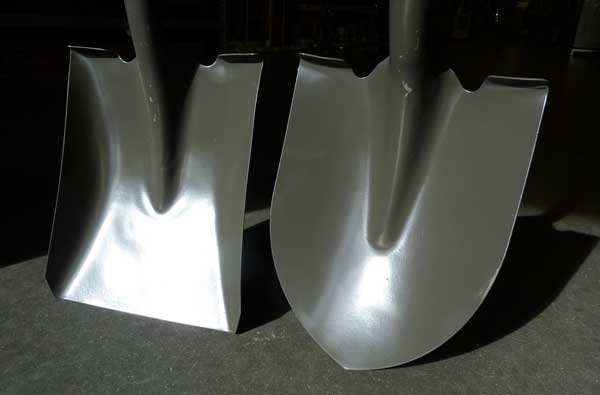
these don’t serve the same function….
That flat shovel can lift an unbelievably thin layer of soil. The round point one is the tester–you know something’s down there, so you cut into the soil with it. (If you click on the picture it’ll take to to a right proper archaeology site :))
The flat shovel is what you use to lift each layer of the memory.
First layer: remember where you are in the memory. Where are you physically, where are you relative to the story, where are you in time?
Second layer: who else is there?
Third: What happened?
Fourth: What was said, and who said what?
Then you start digging with the other shovel and see what you over-turn.
There are some memories I’ve had to sneak up on, just like I would a wispy dream. I tell my brain that my fingers are just fiddling around on the keyboard, and I ignore any possible typos at this point because I’m typing like Stevie Wonder–my eyes are closed, and I’m leaning a little to the left because maybe that’s the way the car was going, and I’m swaying because I know Daddy’s got Johnny Cash on the radio and I’m trying to remember that empty lot on the corner that I liked to play in because I liked the texture of the greasy dirt on the bottoms of my feet.
After you write the bare-boned scene, ask yourself why it is so important. What holds the meaning for you? Why does it hurt to remember it? Or why does it make your heart burst with joy? Maybe you’re standing on the front seat of your daddy’s old white Pontiac, your small hand tucked into the collar of his shirt, and your face is snugged up under his chin where you can smell Old Spice and tobacco, and the memory holds both deep delight and terror, because you’re next to your favorite person, and you know he’s driving drunk…..
Perfectionism is the death of done
“Perfectionism is
the voice of the oppressor,
the enemy of the people.
It will keep you
cramped
and insane
your whole life,
and it is the main obstacle
between you
and a shitty first draft.
I think perfectionism is based
on the obsessive belief
that if you run carefully enough,
hitting
each
stepping-
stone
just
right,
you won’t have to die.
The truth is
that you will die anyway
and that a lot of people
who aren’t even looking
at their feet
are going to do a whole lot better than you,
and have a lot more fun
while they’re doing it.”
Anne Lamott ~ From Bird by Bird
I will add more to this later.
THIS IS PERFECTION:

Dandelion Chandelier
- If you struggle with moving forward because of fears, this may help: http://tinyurl.com/nofeargoddess
Regurgitation: It’s what’s for breakfast
“As writers we live life twice, like a cow that eats its food once and then regurgitates it to chew and digest it again. We have a second chance at biting into our experience and examining it. … This is our life and it’s not going to last forever. There isn’t time to talk about someday writing that short story or poem or novel. Slow down now, touch what is around you, and out of care and compassion for each moment and detail, put pen to paper and begin to write.” —Natalie Goldberg
This idea is repulsive.
I’d prefer not to envision myself as a cow in any way. Furthermore, throwing up what I just ate? And pawing through it to find the good chunks to chow down again? Just thinking about it makes my stomach heave a little.
But I have done this in my writing.
I’ve ingested life through all my pores and then vomited the experiences onto the page.
It’s a matter of having taken in too much too fast and then needing to put all of it into one place so I can pick through it and draw out meaning.
I don’t have the words for anything unless I write it out. If it stays inside, it stays unnamed and unclaimed.
I ingest indiscriminately the first time. The second time I’m far choosier, and those are the things that stick to my bones.
I so wish this didn’t sound like a promotion for bulimia.
 D5 Creation